Vivid
Write a scene and get a storyboard of cinematic pictures. We rebuilt the engine that makes them, and built the test that says whether any change makes them better or worse.
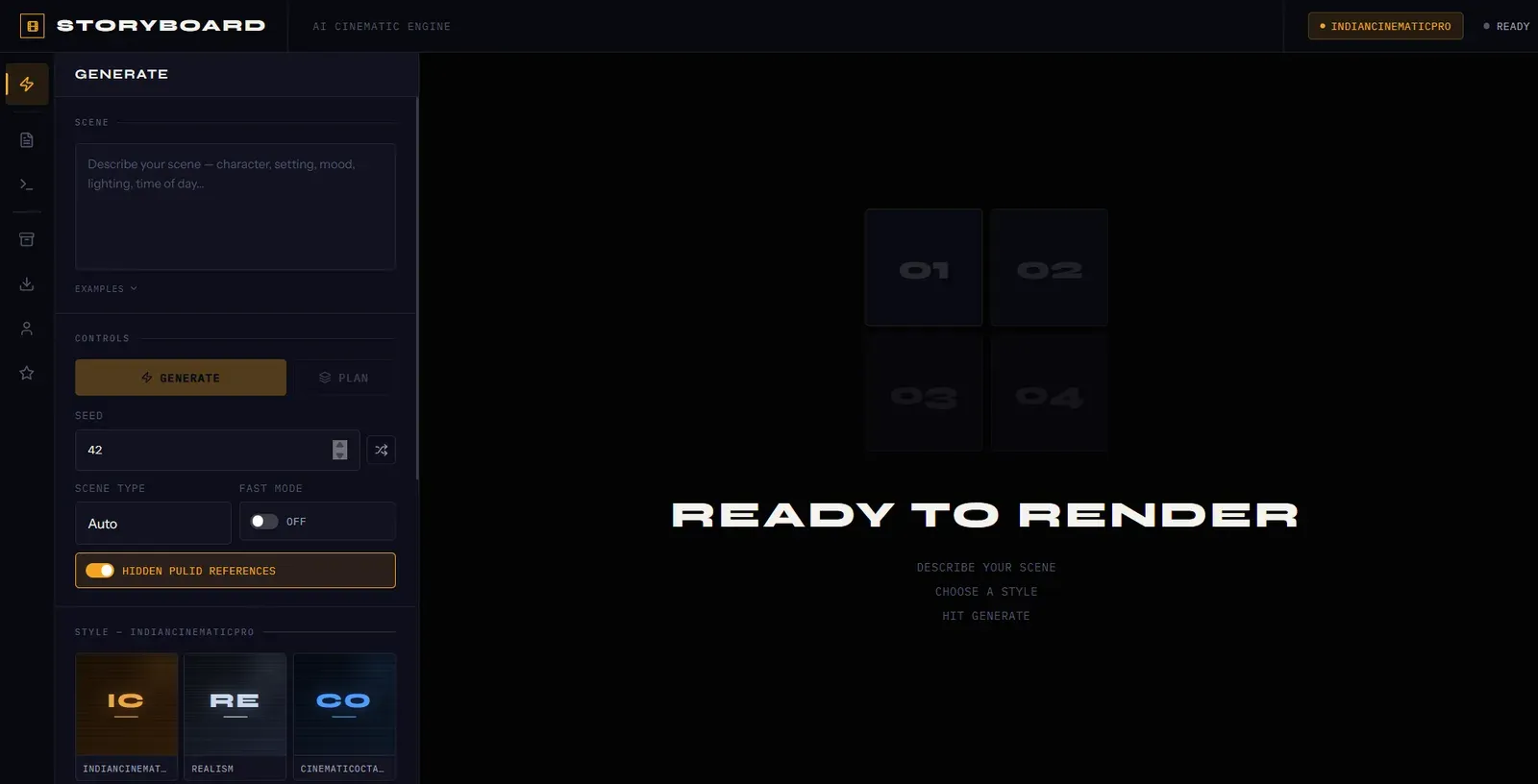
What it is
Vivid turns a written script into a storyboard. An AI plans the shots, an image model draws them, and checks score whether each picture matches the script and keeps the same face from frame to frame.
It is a client’s product. Parth rebuilt the part that makes the pictures.
What we rebuilt
From July 2026 we moved the image pipeline from FLUX.1 to FLUX.2, a newer model that can hold several people in one picture and follows direction more closely. At first it would not even load: the pieces of its text encoder did not match each other. The fourth fix worked: download every piece, join them by hand, and start the model from the joined copy. It now runs on a single GPU.
A way to tell better from worse
Before this, every judgement was someone looking at a picture and saying it looked nice. We built a fixed test: twelve stories and forty-two pictures, run the same way every time and scored on five measures, including whether it is the right person and what it costs. Seventeen full runs so far.
Closed questions
Three ideas were dead ends, and each is now written down with its evidence so nobody walks back into it. The well-known face-locking add-on cannot work on this model, because its published face data is built for a smaller version. Two rewrites of the instructions we give the model each improved some things and failed the overall bar.
The change we did not ship
A turbo setting cut the GPU work per picture by 5.9×. On speed alone it answered every complaint the testers had. The test showed it made faces worse and duplicated people, so we kept the slower setting.
Cheaper to test
A full test run used to cost about ₹250 of GPU time. It now costs about ₹42. That is the difference between testing an idea and not bothering.
What this page does not claim
Vivid is the client’s product, so there is no live link here and no claim about its users. These figures are from August 2026.
How it is built
FLUX.2, a LoRA we trained on a six-stage dataset pipeline, CLIP and ArcFace scoring, FastAPI and React, on a single GPU.
Next build
The airport parking app. Find parking, book a space and pay in the app, with your number plate as the pass. Working on Android phones today, not on the stores yet.
read the build: The airport parking app